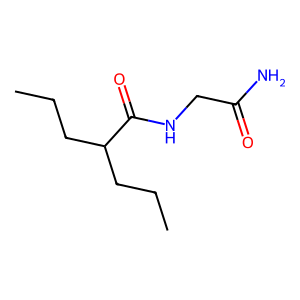
Valrocemide
Names and Identifiers of Valrocemide
CAS Number |
92262-58-3 |
|---|---|
EC Number |
618-831-8 |
IUPAC Name |
N-(2-amino-2-oxoethyl)-2-propylpentanamide |
InChI |
InChI=1S/C10H20N2O2/c1-3-5-8(6-4-2)10(14)12-7-9(11)13/h8H,3-7H2,1-2H3,(H2,11,13)(H,12,14) |
InChIKey |
RALGCAOVRLYSMA-UHFFFAOYSA-N |
Canonical SMILES |
CCCC(CCC)C(=O)NCC(=O)N |
UNII |
1C7GO6OW7L |
Physical and chemical properties of Valrocemide
Appearance of Characters |
white solid |
|---|---|
Boiling Point |
417.5ºC at 760 mmHg |
Density |
0.997 |
Exact Mass |
200.15200 |
Flash Point |
206.3ºC |
Index of Refraction |
1.465 |
LogP |
1.89550 |
Molecular Formula |
C10H20N2O2 |
Molecular Weight |
200.27800 |
PSA |
72.19000 |
Storage condition |
-20℃ |
Applications of Valrocemide
Valrocemide is primarily investigated for its application as an anticonvulsant agent. Its potential use extends beyond epilepsy; it may also be beneficial in treating other neurological disorders where modulation of GABAergic activity is crucial. Additionally, due to its structural similarity to valproic acid, it could serve as a basis for developing further derivatives with improved pharmacological properties.
Interaction Studies of Valrocemide
Valrocemide's interactions with other drugs and biological systems have been explored to understand its pharmacokinetics better. Interaction studies have indicated that it may alter the metabolism of co-administered drugs due to competition for metabolic pathways, particularly those involving cytochrome P450 enzymes. These interactions are essential for assessing drug-drug interactions and optimizing therapeutic regimens.
Biological Activity of Valrocemide
Valrocemide exhibits notable anticonvulsant activity. It has been shown to increase the concentration of gamma-aminobutyric acid (GABA) in the brain, a neurotransmitter that plays a critical role in inhibiting neuronal excitability throughout the nervous system. This mechanism is similar to that of valproic acid but aims to achieve a better safety profile.
Additionally, studies suggest that valrocemide may have a lower incidence of side effects compared to its parent compound, making it a candidate for further clinical investigation in epilepsy management.
Physical sample testing spectrum (NMR) of Valrocemide

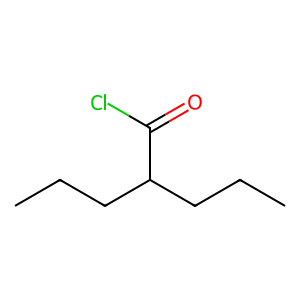 Cas:2936-08-5
