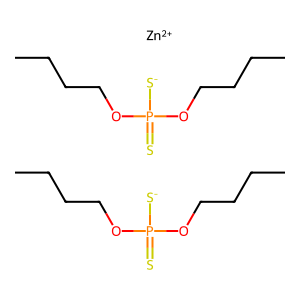
Vocol
Names and Identifiers of Vocol
CAS Number |
6990-43-8 |
|---|---|
EC Number |
246-380-3 |
IUPAC Name |
zinc;dibutoxy-sulfanylidene-sulfido-λ5-phosphane |
InChI |
InChI=1S/2C8H19O2PS2.Zn/c2*1-3-5-7-9-11(12,13)10-8-6-4-2;/h2*3-8H2,1-2H3,(H,12,13);/q;;+2/p-2 |
InChIKey |
MECFLMNXIXDIOF-UHFFFAOYSA-L |
Canonical SMILES |
CCCCOP(=S)(OCCCC)[S-].CCCCOP(=S)(OCCCC)[S-].[Zn+2] |
Physical and chemical properties of Vocol
Boiling Point |
303.7ºC at 760 mmHg |
|---|---|
Exact Mass |
546.026306 |
Flash Point |
137.4ºC |
LogP |
8.08110 |
Molecular Formula |
C16H36O4P2S4Zn |
Molecular Weight |
548.071 |
PSA |
120.72000 |
Safety Information of Vocol


Applications of Vocol
Interaction Studies of Vocol
Research on Vocol's interactions has highlighted its role in various biological processes. For instance, studies indicate that exposure to certain volatile organic compounds can affect skin health by downregulating antimicrobial peptides and exacerbating allergic reactions. Such findings underscore the importance of understanding the dermal absorption effects of Vocol and similar compounds on human health.
Biological Activity of Vocol
Vocol exhibits significant biological activity, particularly in its role as a signaling molecule. In plants and animals, volatile organic compounds like Vocol can serve as attractants for pollinators or as defense mechanisms against herbivores. They also participate in inter-plant communication, influencing growth and stress responses. Furthermore, Vocol has potential applications in medicine, where it may serve as a biomarker for disease diagnosis due to its presence in breath or other biological samples.