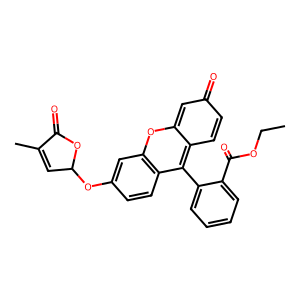
Yoshimulactone Green (YLG)
Names and Identifiers of Yoshimulactone Green (YLG)
CAS Number |
1807549-00-3 |
|---|---|
IUPAC Name |
ethyl 2-[3-[(4-methyl-5-oxo-2H-furan-2-yl)oxy]-6-oxoxanthen-9-yl]benzoate |
InChI |
InChI=1S/C27H20O7/c1-3-31-27(30)19-7-5-4-6-18(19)25-20-10-8-16(28)13-22(20)33-23-14-17(9-11-21(23)25)32-24-12-15(2)26(29)34-24/h4-14,24H,3H2,1-2H3 |
InChIKey |
CHRFZINIRYDHJV-UHFFFAOYSA-N |
Canonical SMILES |
CCOC(=O)C1=CC=CC=C1C2=C3C=CC(=O)C=C3OC4=C2C=CC(=C4)OC5C=C(C(=O)O5)C |
Physical and chemical properties of Yoshimulactone Green (YLG)
Boiling Point |
735.1±60.0 °C at 760 mmHg |
|---|---|
Density |
1.4±0.1 g/cm3 |
Exact Mass |
456.120911 |
Flash Point |
315.0±32.9 °C |
Index of Refraction |
1.666 |
LogP |
3.19 |
Melting Point |
190 °C |
Molecular Formula |
C27H20O7 |
Molecular Weight |
456.444 |
Vapour Pressure |
0.0±2.4 mmHg at 25°C |
Applications of Yoshimulactone Green (YLG)
Yoshimulactone Green has several applications in both research and agricultural contexts:
- High-Throughput Screening: Utilized for identifying new ligands that interact with strigolactone receptors, aiding in crop improvement strategies.
- Plant Growth Regulation: By modulating strigolactone signaling, it can potentially enhance crop yields and biomass through controlled branching .
- Research Tool: Serves as a probe for studying strigolactone signaling pathways and their biological implications in various plant species .
Interaction Studies of Yoshimulactone Green (YLG)
Interaction studies using Yoshimulactone Green have revealed its ability to compete with natural strigolactones for binding to receptors like DWARF14. These studies typically involve fluorescence assays where changes in fluorescence intensity indicate binding events and receptor activity. For instance, Yoshimulactone Green has been employed to assess the binding affinities of various synthetic compounds against D14, providing insights into their potential as agricultural tools .
Biological Activity of Yoshimulactone Green (YLG)
Yoshimulactone Green plays a significant role in plant biology by serving as a fluorescent substrate to study the mechanisms of strigolactone perception. It has been shown to facilitate the identification of small molecules that can inhibit or modulate the activity of strigolactone receptors, thereby influencing plant growth and branching . The fluorescence generated by Yoshimulactone Green allows researchers to monitor receptor activity and assess the binding affinity of various compounds in real time.