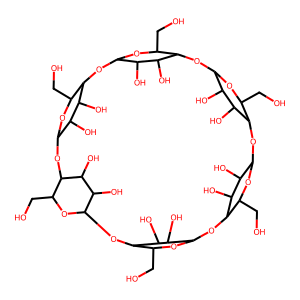
alpha-CYCLODEXTRIN
Names and Identifiers of alpha-CYCLODEXTRIN
CAS Number |
10016-20-3 |
|---|---|
EC Number |
233-007-4 |
MDL Number |
MFCD00078207 |
IUPAC Name |
(1S,3R,5R,6S,8R,10R,11S,13R,15R,16S,18R,20R,21S,23R,25R,26S,28R,30R,31R,32R,33R,34R,35R,36R,37R,38R,39R,40R,41R,42R)-5,10,15,20,25,30-hexakis(hydroxymethyl)-2,4,7,9,12,14,17,19,22,24,27,29-dodecaoxaheptacyclo[26.2.2.23,6.28,11.213,16.218,21.223,26]dotetracontane-31,32,33,34,35,36,37,38,39,40,41,42-dodecol |
InChI |
InChI=1S/C36H60O30/c37-1-7-25-13(43)19(49)31(55-7)62-26-8(2-38)57-33(21(51)15(26)45)64-28-10(4-40)59-35(23(53)17(28)47)66-30-12(6-42)60-36(24(54)18(30)48)65-29-11(5-41)58-34(22(52)16(29)46)63-27-9(3-39)56-32(61-25)20(50)14(27)44/h7-54H,1-6H2/t7-,8-,9-,10-,11-,12-,13-,14-,15-,16-,17-,18-,19-,20-,21-,22-,23-,24-,25-,26-,27-,28-,29-,30-,31-,32-,33-,34-,35-,36-/m1/s1 |
InChIKey |
HFHDHCJBZVLPGP-RWMJIURBSA-N |
Canonical SMILES |
C(C1C2C(C(C(O1)OC3C(OC(C(C3O)O)OC4C(OC(C(C4O)O)OC5C(OC(C(C5O)O)OC6C(OC(C(C6O)O)OC7C(OC(O2)C(C7O)O)CO)CO)CO)CO)CO)O)O)O |
Isomeric SMILES |
C([C@@H]1[C@@H]2[C@@H]([C@H]([C@H](O1)O[C@@H]3[C@H](O[C@@H]([C@@H]([C@H]3O)O)O[C@@H]4[C@H](O[C@@H]([C@@H]([C@H]4O)O)O[C@@H]5[C@H](O[C@@H]([C@@H]([C@H]5O)O)O[C@@H]6[C@H](O[C@@H]([C@@H]([C@H]6O)O)O[C@@H]7[C@H](O[C@H](O2)[C@@H]([C@H]7O)O)CO)CO)CO)CO)CO)O)O)O |
UNII |
Z1LH97KTRM |
UNSPSC Code |
12352100 |
Physical and chemical properties of alpha-CYCLODEXTRIN
Acidity coefficient |
11.77±0.70(Predicted) |
|---|---|
Boiling Point |
1410.8±60.0 °C at 760 mmHg |
BRN |
4227442 |
Density |
1.6±0.1 g/cm3 |
Exact Mass |
972.316956 |
Flash Point |
807.1±32.9 °C |
H Bond Acceptors |
30 |
H Bond Donors |
18 |
Index of Refraction |
1.591 |
LogP |
-6.55 |
Melting Point |
532 °F (decomposes) (NTP, 1992) |
Merck |
14,2718 |
Molecular Formula |
C36H60O30 |
Molecular Weight |
972.844 |
optical activity |
[α]20/D +136±3°, c = 10% in H2O |
pH |
5.0-8.0 (1% in solution) |
PSA |
474.90000 |
Solubility |
H2O: 50 mg/mL |
Specific rotation |
[α]D25 +146~+151° (c=1, H2O) (After Drying) |
Stability |
Stable. Combustible. Incompatible with strong oxidizing agents. |
Storage condition |
Store at RT. |
Vapour Pressure |
0.0±0.6 mmHg at 25°C |
Water Solubility |
H2O: 50 mg/mL |
Solubility of alpha-CYCLODEXTRIN
| Solvent | Dissolution Behavior | Temperature Effect | pH Effect |
|---|---|---|---|
| Water | Soluble, solubility approximately 14.5% (w/w) | Solubility increases significantly with rising temperature | Stable under neutral to weakly acidic conditions; may hydrolyze under strong alkaline conditions |
| Ethanol | Slightly soluble (approximately 0.1–0.3%) | Solubility improves slightly with increasing temperature, but remains low overall | Insensitive to pH changes, but high ethanol concentrations may reduce solubility |
| Methanol | Slightly soluble | Modest improvement with temperature, but still limited | Similar to ethanol; stability is minimally affected by environmental conditions |
| Acetone | Practically insoluble | No significant improvement | No notable effect |
| Acetonitrile | Very slightly soluble | Virtually no improvement | No significant effect |
| Dimethyl sulfoxide (DMSO) | Freely soluble (>20%) | Solubility increases with rising temperature | Stable over a wide pH range, but may degrade under strongly acidic or basic conditions |
| Glycerol | Soluble (solubility slightly lower than in water) | Increased temperature promotes dissolution | Stable under neutral conditions; side reactions may occur under strong acidic conditions |
Safety Information of alpha-CYCLODEXTRIN

Key Milestone of alpha-CYCLODEXTRIN
| Year | Event | Description |
|---|---|---|
| 1891 | First Discovery | French scientist Villiers first isolated a crystalline substance from the fermentation products of starch using Bacillus amylobacter. This substance was later confirmed to be a mixture of cyclodextrins, including α-cyclodextrin. |
| 1903–1911 | Initial Structural Elucidation | German chemist Franz Schardinger further studied this compound, isolating two major components (later named α- and β-cyclodextrins), and confirmed they were composed of glucose units. As a result, cyclodextrins were initially referred to as "Schardinger dextrins." |
| 1930s–1950s | Chemical Structure Confirmation | Through chemical degradation and X-ray diffraction analyses, scientists confirmed that α-cyclodextrin consists of six D-glucopyranose units linked by α-1,4-glycosidic bonds, forming a cyclic oligosaccharide. |
| 1950s–1970s | Process Optimization for Production | Methods utilizing cyclodextrin glucanotransferase (CGTase) to efficiently produce α-cyclodextrin from starch were developed, significantly improving yield and purity, laying the foundation for industrial-scale production. |
| 1970s–1980s | Deepened Research on Inclusion Properties | It was discovered that α-cyclodextrin has a hydrophobic cavity and a hydrophilic outer surface, enabling it to form inclusion complexes with various small molecules. This property enhances solubility, stability, and bioavailability, driving its exploration in drug delivery systems. |
| 1980s–1990s | Applications in Food and Cosmetics | Due to its high safety profile (GRAS status), α-cyclodextrin was widely used in the food industry (e.g., stabilizing flavors, removing off-flavors) and cosmetics (e.g., controlled release of active ingredients, improved stability). |
| 1990s–2000s | Development as Pharmaceutical Excipients | α-Cyclodextrin and its derivatives were employed to enhance the solubility and stability of poorly water-soluble drugs; some formulations entered clinical research. Systematic toxicological and pharmacokinetic evaluations were also conducted. |
| 2000s–2010s | Expansion into Functional Materials | Applications expanded into environmental remediation (e.g., adsorption of organic pollutants), analytical chemistry (chiral separation), and nanotechnology (construction of supramolecular assemblies). |
| 2010s – Present | Emerging Applications and Regulatory Approval | Approved by the EU, FDA, and other regulatory bodies as a food additive (E459) and pharmaceutical excipient. Active research continues in frontier areas such as precision medicine, targeted delivery, and smart responsive materials. |
Applications of alpha-CYCLODEXTRIN
Interaction Studies of alpha-CYCLODEXTRIN
Studies on interaction dynamics between alpha-cyclodextrin and various guest molecules reveal that the size and polarity of the guest significantly influence complex formation. The binding strength varies based on the compatibility of the guest molecule with the hydrophobic cavity of alpha-cyclodextrin. Research indicates that smaller, less polar molecules tend to form more stable complexes compared to larger or more polar ones. Additionally, pH and temperature can affect the stability of these complexes.
Biological Activity of alpha-CYCLODEXTRIN
Alpha-cyclodextrin exhibits notable biological activities, including enhancing the solubility and bioavailability of poorly soluble drugs. Its hydrophilic exterior and hydrophobic cavity allow it to interact with various biological molecules, which can improve drug delivery systems. Furthermore, alpha-cyclodextrin has been studied for its potential use in encapsulating flavors and fragrances in the food industry, thereby improving product stability and sensory properties.
Physical sample testing spectrum (NMR) of alpha-CYCLODEXTRIN
