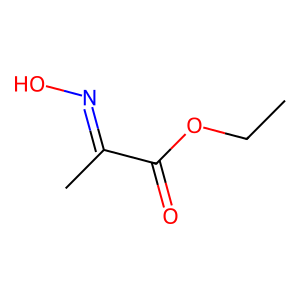
ethyl (2E)-2-(hydroxyimino)propanoate
CAS No.:
20591-87-1
M. Wt:
131.13000
M. Fa:
C5H9NO3
InChI Key:
BJBDPHKMAMMTFW-GQCTYLIASA-N
Names and Identifiers of ethyl (2E)-2-(hydroxyimino)propanoate
CAS Number |
20591-87-1 |
|---|---|
EC Number |
661-178-9 |
IUPAC Name |
ethyl (2E)-2-hydroxyiminopropanoate |
InChI |
InChI=1S/C5H9NO3/c1-3-9-5(7)4(2)6-8/h8H,3H2,1-2H3/b6-4+ |
InChIKey |
BJBDPHKMAMMTFW-GQCTYLIASA-N |
Canonical SMILES |
CCOC(=O)C(=NO)C |
Isomeric SMILES |
CCOC(=O)/C(=N/O)/C |
Physical and chemical properties of ethyl (2E)-2-(hydroxyimino)propanoate
Boiling Point |
209.8ºC at 760 mmHg |
|---|---|
Density |
1.12g/cm3 |
Exact Mass |
131.05800 |
Flash Point |
80.7ºC |
Index of Refraction |
1.449 |
LogP |
0.39960 |
Molecular Formula |
C5H9NO3 |
Molecular Weight |
131.13000 |
PSA |
58.89000 |
Vapour Pressure |
0.0455mmHg at 25°C |
Safety Information of ethyl (2E)-2-(hydroxyimino)propanoate

Applications of ethyl (2E)-2-(hydroxyimino)propanoate
Ethyl (2E)-2-(hydroxyimino)propanoate has several potential applications:
- Chemical Intermediates: It serves as a precursor for synthesizing more complex organic molecules.
- Pharmaceutical Development: Due to its structural features, it may be explored for developing new drugs or therapeutic agents.
- Agricultural Chemicals: Its biological activity could be harnessed for developing agrochemicals or pesticides.
The versatility of this compound makes it valuable across various scientific disciplines.
Interaction Studies of ethyl (2E)-2-(hydroxyimino)propanoate
Studies on interaction mechanisms involving ethyl (2E)-2-(hydroxyimino)propanoate are essential for understanding its reactivity and potential applications. Research focusing on:
- Molecular Docking Studies: These can predict how the compound interacts with biological targets, providing insights into its potential pharmacological effects.
- Spectroscopic Studies: Techniques such as NMR and IR spectroscopy help elucidate structural characteristics and confirm interactions with other molecules.
Such studies contribute to a deeper understanding of the compound's behavior in biological systems and its synthetic utility.
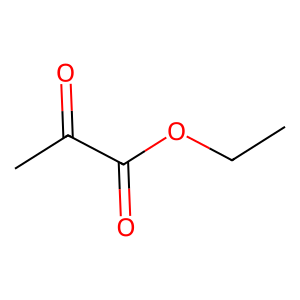 Cas:617-35-6

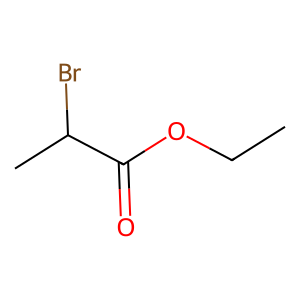 Cas:535-11-5