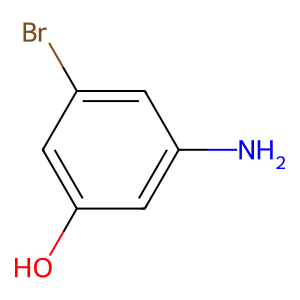
no
CAS No.:
100367-38-2
M. Wt:
188.022
M. Fa:
C6H6BrNO
InChI Key:
MITPOGKUUPJAPC-UHFFFAOYSA-N
Appearance:
Very Dark Brown Solid
Names and Identifiers of no
CAS Number |
100367-38-2 |
|---|---|
MDL Number |
MFCD16999374 |
IUPAC Name |
3-amino-5-bromophenol |
InChI |
InChI=1S/C6H6BrNO/c7-4-1-5(8)3-6(9)2-4/h1-3,9H,8H2 |
InChIKey |
MITPOGKUUPJAPC-UHFFFAOYSA-N |
Canonical SMILES |
NC1=CC(O)=CC(Br)=C1 |
UNSPSC Code |
12352100 |
Physical and chemical properties of no
Boiling Point |
319.2±22.0 °C at 760 mmHg |
|---|---|
Density |
1.8±0.1 g/cm3 |
Exact Mass |
186.963272 |
Flash Point |
146.8±22.3 °C |
Index of Refraction |
1.677 |
LogP |
1.88 |
Molecular Formula |
C6H6BrNO |
Molecular Weight |
188.022 |
PSA |
46.25000 |
Vapour Pressure |
0.0±0.7 mmHg at 25°C |
Safety Information of no

Applications of no
3-Amino-5-bromophenol finds applications in various fields:
- Pharmaceutical Industry: It is utilized as an intermediate in the synthesis of pharmaceuticals, particularly those with antimicrobial properties.
- Dye Manufacturing: The compound serves as a precursor for the production of dyes and pigments due to its reactivity and ability to form stable colored products.
- Analytical Chemistry: It is used as a reagent in analytical methods for detecting specific ions or compounds.
Interaction Studies of no
Interaction studies involving 3-amino-5-bromophenol have focused on its reactivity with biological molecules:
- Protein Interactions: Research has indicated that this compound can interact with proteins, potentially affecting their function or stability.
- Metal Ion Complexation: The ability of 3-amino-5-bromophenol to form complexes with metal ions has been studied, revealing potential applications in metal ion detection and removal.
Biological Activity of no
Research indicates that 3-amino-5-bromophenol exhibits various biological activities:
- Antimicrobial Properties: Studies have shown that this compound possesses antimicrobial activity against certain bacteria and fungi, making it useful in pharmaceutical formulations.
- Antioxidant Activity: The compound has demonstrated potential antioxidant properties, which may contribute to its protective effects against oxidative stress in biological systems.
Physical sample testing spectrum (NMR) of no

 Cas:116632-23-6
