
p-Anisic acid
Names and Identifiers of p-Anisic acid
CAS Number |
100-09-4 |
|---|---|
EC Number |
202-818-5 |
MDL Number |
MFCD00002542 |
IUPAC Name |
4-methoxybenzoic acid |
InChI |
InChI=1S/C8H8O3/c1-11-7-4-2-6(3-5-7)8(9)10/h2-5H,1H3,(H,9,10) |
InChIKey |
ZEYHEAKUIGZSGI-UHFFFAOYSA-N |
Canonical SMILES |
COC1=CC=C(C=C1)C(=O)O |
UNII |
4SB6Y7DMM3 |
UNSPSC Code |
12352100 |
Physical and chemical properties of p-Anisic acid
Acidity coefficient |
4.50(at 25℃) |
|---|---|
Boiling Point |
278.3±13.0 °C at 760 mmHg |
BRN |
508910 |
Density |
1.2±0.1 g/cm3 |
Exact Mass |
152.047348 |
Flash Point |
115.5±13.3 °C |
Index of Refraction |
1.546 |
LogP |
1.96 |
Melting Point |
185 °C |
Merck |
14,666 |
Molecular Formula |
C8H8O3 |
Molecular Weight |
152.147 |
pH |
3-4 (0.3g/l, H2O, 20℃) |
PSA |
46.53000 |
Solubility |
freely soluble (in ethanol) |
Stability |
Stable. Incompatible with strong oxidizing agents. |
Storage condition |
Store below +30°C. |
Vapour Pressure |
0.0015 [mmHg] |
Water Solubility |
Soluble in water at 20°C 0.3g/L. Soluble in alcohol, ethyl acetate and ether. |
Safety Information of p-Anisic acid

Key Milestone of p-Anisic acid
| Year | Event Description | Significance and Impact |
|---|---|---|
| Early 1840s | First isolation of p-methoxybenzoic acid or its derivatives from plant sources | Possibly discovered by European chemists during studies on natural products like anise and star anise oil, marking the compound's entry into the scientific field. Although not yet named, it laid the foundation for subsequent structural identification. |
| around 1870 | Chemical structure was identified as 4-methoxybenzoic acid | With the development of organic structural theory (e.g., the work of Kekulé), the molecular structure of p-methoxybenzoic acid was confirmed and classified as a methoxy-substituted derivative of benzoic acid. |
| Late 19th to early 20th century | Began to be used as a fragrance and pharmaceutical intermediate | Used in the synthesis of vanillin, pharmaceutical intermediates, and other aromatic compounds, becoming an important raw material in fine chemical industries. |
| 1930–1950s | Found to have certain antibacterial properties during antimicrobial research | Studies showed it had inhibitory effects on certain microorganisms, promoting its exploration and application in preservatives. |
| 1960s | Became a standard or reference substance in high-performance liquid chromatography (HPLC) and thin-layer chromatography (TLC) | Due to its stable physicochemical properties, it was widely used as a reference compound in analytical chemistry, especially in the analysis of natural products and metabolites. |
| 1970–1980s | Used in the synthesis of pharmaceuticals such as antifungal agents and nonsteroidal anti-inflammatory drugs (NSAIDs) | Served as a synthetic building block in the pharmaceutical industry for constructing more complex drug molecules, improving synthetic efficiency. |
| Since the 1990s | Widely applied in the fields of flavors, fragrances, cosmetics, and food additives | Used as a flavor modifier or stabilizer, providing a soft floral or fruity aroma in perfumes and food flavorings. |
| Early 21st century | Studied as a model substrate in green chemistry and sustainable synthesis | Used in research on novel reactions such as catalytic oxidation and C–H activation, promoting the development of environmentally friendly synthetic methods. |
| Recent years (2020s) | Exploring potential applications in bio-based materials and drug delivery systems | Researching the application prospects of its derivatives in smart materials and targeted drug carriers, expanding high-value applications. |
Applications of p-Anisic acid
The applications of 4-Methoxybenzoic acid span various industries:
- Pharmaceuticals: It serves as an intermediate in the synthesis of analgesics like paracetamol and other pharmaceutical compounds.
- Material Science: The compound is utilized in producing high-performance polymers and resins through polycondensation reactions, enhancing material durability and chemical resistance.
- Food Industry: It is used as a preservative and flavoring agent due to its sweet flavor profile.
Interaction Studies of p-Anisic acid
Research on interaction studies involving 4-Methoxybenzoic acid indicates its role in various biochemical pathways. For instance, its interaction with cytochrome P450 enzymes facilitates its metabolic conversion into hydroxylated derivatives, which may have different biological activities compared to the parent compound. Additionally, studies have explored its interactions with other organic compounds in synthetic pathways.
Biological Activity of p-Anisic acid
4-Methoxybenzoic acid exhibits several biological activities. It has been shown to possess antiseptic properties and can act as a plant metabolite. Additionally, studies indicate that it can be demethylated by cytochrome P450 enzymes, leading to the formation of 4-hydroxybenzoic acid, which has further implications in pharmacological applications.
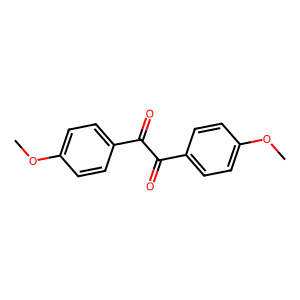 Cas:1226-42-2


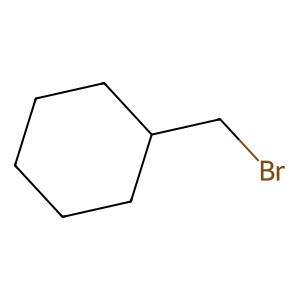 Cas:2550-36-9
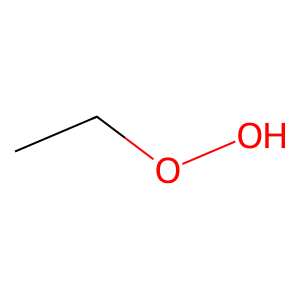 Cas:3031-74-1