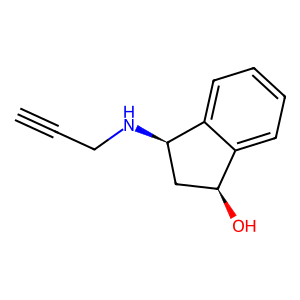
rac-cis-1-Deshydroxy Rasagiline
CAS No.:
1429220-15-4
M. Wt:
187.24
M. Fa:
C12H13NO
InChI Key:
-
Names and Identifiers of rac-cis-1-Deshydroxy Rasagiline
CAS Number |
1429220-15-4 |
|---|---|
IUPAC Name |
(1S,3R)-3-(prop-2-ynylamino)-2,3-dihydro-1H-inden-1-ol |
Canonical SMILES |
C#CCN[C@@H]1C[C@@H](C2=CC=CC=C12)O |
Physical and chemical properties of rac-cis-1-Deshydroxy Rasagiline
Molecular Formula |
C12H13NO |
|---|---|
Molecular Weight |
187.24 |
Applications of rac-cis-1-Deshydroxy Rasagiline
Rac-cis-1-Deshydroxy Rasagiline has several applications:
- Medicinal Chemistry: It is studied for its potential as an active pharmaceutical ingredient or intermediate in drug development.
- Organic Synthesis: The compound serves as a building block for synthesizing more complex molecules in organic chemistry.
- Biological Studies: Researchers investigate its biological activity and therapeutic effects, particularly concerning neurodegenerative diseases.
- Industrial
Interaction Studies of rac-cis-1-Deshydroxy Rasagiline
Similar Compounds
Rac-cis-1-Deshydroxy Rasagiline shares similarities with several other compounds:
| Compound Name | Structural Features | Unique Aspects |
|---|---|---|
| Rac-trans-1-Deshydroxy Rasagiline | Indene backbone, prop-2-ynylamino group | Different stereochemistry affecting activity |
| Indan-1-Ol | Indene derivative | Lacks the propynylamino group |
| Propargylamine | Contains propynylamino group | Simpler structure without indene backbone |
| Indene-2-Carboxylic Acid | Indene derivative | Functionalized differently compared to Rac-cis |
Biological Activity of rac-cis-1-Deshydroxy Rasagiline
Rac-cis-1-Deshydroxy Rasagiline primarily acts as an irreversible inhibitor of monoamine oxidase B. By inhibiting this enzyme, the compound increases the levels of dopamine in the brain, which can lead to improved motor function in patients with Parkinson's disease. Research indicates that it may also interact with other biological targets beyond monoamine oxidase B, suggesting a broader pharmacological profile. Its effects on dopaminergic pathways make it a candidate for further investigation in neuropharmacology.