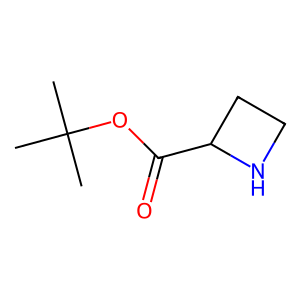
tert-Butyl azetidine-2-carboxylate
Names and Identifiers of tert-Butyl azetidine-2-carboxylate
CAS Number |
208034-97-3 |
|---|---|
IUPAC Name |
tert-butyl azetidine-2-carboxylate |
InChI |
InChI=1S/C8H15NO2/c1-8(2,3)11-7(10)6-4-5-9-6/h6,9H,4-5H2,1-3H3 |
InChIKey |
KHNFEQCEQIAFES-UHFFFAOYSA-N |
Canonical SMILES |
CC(C)(C)OC(=O)C1CCN1 |
Physical and chemical properties of tert-Butyl azetidine-2-carboxylate
Boiling Point |
196.5±33.0 °C at 760 mmHg |
|---|---|
Density |
1.0±0.1 g/cm3 |
Exact Mass |
157.110275 |
Flash Point |
72.6±25.4 °C |
Index of Refraction |
1.457 |
LogP |
0.86 |
Molecular Formula |
C8H15NO2 |
Molecular Weight |
157.210 |
PSA |
38.33000 |
Storage condition |
Keep in dark place,Sealed in dry,Store in freezer, under -20°C |
Vapour Pressure |
0.4±0.4 mmHg at 25°C |
Safety Information of tert-Butyl azetidine-2-carboxylate

Applications of tert-Butyl azetidine-2-carboxylate
Tert-butyl azetidine-2-carboxylate finds applications in several fields:
- Pharmaceuticals: Its derivatives are explored for their potential as drug candidates due to their biological activities.
- Synthetic Chemistry: It serves as a versatile building block for synthesizing complex organic molecules.
- Material Science: The compound may be utilized in developing novel materials with specific properties due to its unique structure.
Interaction Studies of tert-Butyl azetidine-2-carboxylate
Studies on interaction mechanisms involving tert-butyl azetidine-2-carboxylate have revealed insights into its reactivity and binding affinities with various biological targets. These interactions are critical for understanding how modifications to the compound's structure can influence its pharmacological properties. For example, research on its binding interactions with enzymes or receptors can provide valuable information for drug design .
Biological Activity of tert-Butyl azetidine-2-carboxylate
Tert-butyl azetidine-2-carboxylate has been studied for its potential biological activities. Compounds containing the azetidine structure have shown promise in various pharmacological applications, including:
- Antimicrobial Activity: Some derivatives exhibit activity against bacterial strains.
- Anticancer Properties: Certain studies suggest that azetidine derivatives may inhibit cancer cell proliferation.
- Neuroprotective Effects: Research indicates potential neuroprotective effects, making them candidates for treating neurodegenerative diseases.
These biological activities are often attributed to the unique structural features of the azetidine ring and its ability to interact with biological targets.