
tert-butyl N-(3-chlorophenyl)carbamate
Names and Identifiers of tert-butyl N-(3-chlorophenyl)carbamate
CAS Number |
5330-63-2 |
|---|---|
MDL Number |
MFCD07127698 |
IUPAC Name |
tert-butyl N-(3-chlorophenyl)carbamate |
InChI |
InChI=1S/C11H14ClNO2/c1-11(2,3)15-10(14)13-9-6-4-5-8(12)7-9/h4-7H,1-3H3,(H,13,14) |
InChIKey |
NHKRPSNCGCLFHJ-UHFFFAOYSA-N |
Canonical SMILES |
CC(C)(C)OC(=O)NC1=CC(=CC=C1)Cl |
UNSPSC Code |
12352100 |
Physical and chemical properties of tert-butyl N-(3-chlorophenyl)carbamate
Boiling Point |
263.8ºC at 760 mmHg |
|---|---|
Density |
1.195g/cm3 |
Exact Mass |
227.07100 |
Flash Point |
113.4ºC |
H Bond Acceptors |
2 |
H Bond Donors |
1 |
Index of Refraction |
1.554 |
LogP |
3.76000 |
Molecular Formula |
C11H14ClNO2 |
Molecular Weight |
227.68700 |
PSA |
38.33000 |
Safety Information of tert-butyl N-(3-chlorophenyl)carbamate

Applications of tert-butyl N-(3-chlorophenyl)carbamate
Tert-butyl N-(3-chlorophenyl)carbamate has potential applications in several fields:
- Medicinal Chemistry: Due to its biological activity, it may serve as a lead compound for developing new pharmaceuticals targeting specific enzymes.
- Organic Synthesis: It can be used as an intermediate in synthesizing more complex organic molecules.
- Agricultural Chemicals: Compounds like this may find applications in developing herbicides or pesticides due to their reactivity and biological activity.
Interaction Studies of tert-butyl N-(3-chlorophenyl)carbamate
Studies on interaction mechanisms indicate that tert-butyl N-(3-chlorophenyl)carbamate may form stable complexes with target enzymes, thereby inhibiting their function. This property is particularly relevant in understanding its potential therapeutic effects and toxicological profiles. Further research is needed to elucidate the specific interactions and pathways involved.
Biological Activity of tert-butyl N-(3-chlorophenyl)carbamate
The biological activity of tert-butyl N-(3-chlorophenyl)carbamate has been linked to its ability to interact with specific enzymes. Similar to other carbamate derivatives, it may inhibit enzymes such as acetylcholinesterase by forming covalent bonds with their active sites. Such interactions can lead to significant physiological effects, making this compound a subject of interest in pharmacological studies.
Physical sample testing spectrum (NMR) of tert-butyl N-(3-chlorophenyl)carbamate

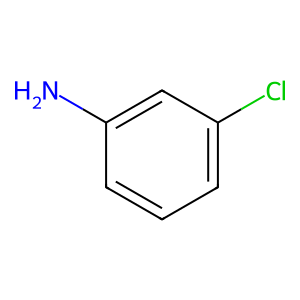 Cas:108-42-9


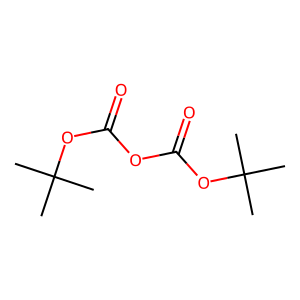 Cas:24424-99-5
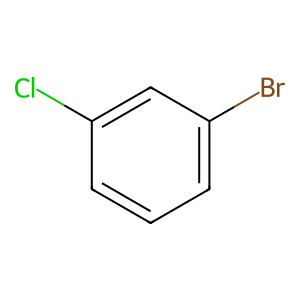 Cas:108-37-2
 Cas:67-63-0