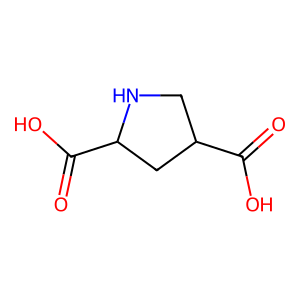
trans-4-Carboxy-L-proline
Names and Identifiers of trans-4-Carboxy-L-proline
CAS Number |
64769-66-0 |
|---|---|
EC Number |
636-355-9 |
IUPAC Name |
(2S,4R)-pyrrolidine-2,4-dicarboxylic acid |
InChI |
InChI=1S/C6H9NO4/c8-5(9)3-1-4(6(10)11)7-2-3/h3-4,7H,1-2H2,(H,8,9)(H,10,11)/t3-,4+/m1/s1 |
InChIKey |
NRSBQSJHFYZIPH-DMTCNVIQSA-N |
Canonical SMILES |
C1C(CNC1C(=O)O)C(=O)O |
Isomeric SMILES |
C1[C@H](CN[C@@H]1C(=O)O)C(=O)O |
Physical and chemical properties of trans-4-Carboxy-L-proline
Boiling Point |
355.3ºC at 760 mmHg |
|---|---|
Density |
1.456 g/cm3 |
Exact Mass |
159.05300 |
Flash Point |
168.7ºC |
Index of Refraction |
1.534 |
Melting Point |
214-217oC |
Molecular Formula |
C6H9NO4 |
Molecular Weight |
159.14000 |
PSA |
86.63000 |
Solubility |
Water (Slightly) |
Storage condition |
Store at RT |
Safety Information of trans-4-Carboxy-L-proline

Applications of trans-4-Carboxy-L-proline
Trans-4-Carboxy-L-proline has diverse applications across several fields:
- Neuroscience Research: It is widely used to study glutamate transport mechanisms and their implications in neurological disorders.
- Pharmaceutical Development: The compound serves as a lead structure for developing new drugs targeting excitatory amino acid transporters.
- Chemical Synthesis: Its unique structure allows it to be used as a building block in synthesizing more complex organic molecules.
Interaction Studies of trans-4-Carboxy-L-proline
Research has shown that trans-4-Carboxy-L-proline interacts with various proteins involved in neurotransmitter transport. Notably, it binds competitively to excitatory amino acid transporters, preventing glutamate uptake and leading to increased extracellular levels of this neurotransmitter. These interactions are crucial for understanding how alterations in glutamate signaling can affect neuronal function and contribute to disease states.
Biological Activity of trans-4-Carboxy-L-proline
Trans-4-Carboxy-L-proline exhibits significant biological activity, primarily as an inhibitor of excitatory amino acid transporters. It competes with glutamate, a key neurotransmitter, thereby influencing neurotransmission and neuronal excitability. This property makes it a valuable tool in neurochemical research, particularly in studies related to neurological disorders such as epilepsy and neurodegenerative diseases. The compound's ability to modulate glutamate levels can help researchers understand the underlying mechanisms of these conditions and develop potential therapeutic strategies.
 Cas:51-35-4

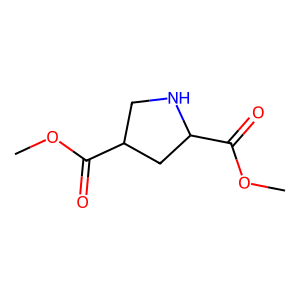 Cas:64750-03-4
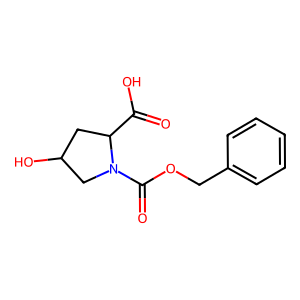 Cas:13504-85-3