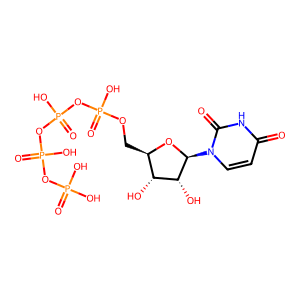
uridine 5'-tetraphosphate
Names and Identifiers of uridine 5'-tetraphosphate
CAS Number |
10003-94-8 |
|---|---|
IUPAC Name |
[[(2R,3S,4R,5R)-5-[2,4-bis(oxidanylidene)pyrimidin-1-yl]-3,4-bis(oxidanyl)oxolan-2-yl]methoxy-oxidanyl-phosphoryl] [oxidanyl(phosphonooxy)phosphoryl] hydrogen phosphate |
Canonical SMILES |
C1=CN(C(=O)NC1=O)[C@H]2[C@@H]([C@@H]([C@H](O2)COP(=O)(O)OP(=O)(O)OP(=O)(O)OP(=O)(O)O)O)O |
Physical and chemical properties of uridine 5'-tetraphosphate
Acidity coefficient |
0.73±0.50(Predicted) |
|---|---|
Density |
2.187g/cm3 |
Exact Mass |
563.93500 |
Index of Refraction |
1.643 |
Molecular Formula |
C9H16N2O18P4 |
Molecular Weight |
564.12100 |
PSA |
350.40000 |
Applications of uridine 5'-tetraphosphate
Uridine 5'-tetraphosphate has potential applications in biochemical research, particularly in studies focused on nucleotide metabolism and signaling pathways. Its role as a substrate for kinases makes it a candidate for exploring enzyme kinetics and interactions within cellular systems. Additionally, due to its structural similarity to other nucleotides, it may serve as a tool for studying RNA synthesis and function.
Interaction Studies of uridine 5'-tetraphosphate
Interaction studies involving uridine 5'-tetraphosphate are still emerging. Preliminary research suggests that it may interact with various enzymes and receptors involved in nucleotide metabolism and signal transduction. For instance, it could potentially modulate the activity of kinases or phosphatases, influencing cellular responses to external stimuli. Further studies are required to elucidate these interactions comprehensively.